
Thread milling and tapping are alternative ways to produce internal threads. The right starting point is the part specification and the machine's capability, rather than a blanket rule that one method is better.
Compare the requirements before the tools
| Decision | Thread milling | Tapping |
|---|---|---|
| Machine and motion | Verify the required interpolation, toolpath and clearance. | Verify the suitable tapping cycle and synchronization. |
| Hole and thread | Check thread form, pitch, diameter, depth and cutter access. | Check thread form, pitch, depth, tap style and hole preparation. |
| Tool selection | Match the cutter form and usable length to the feature. | Match the tap and its geometry to the material and hole type. |
| Process economics | Include programming, cycle, inspection and tool costs. | Include cycle, tool, chip-control and inspection costs. |
Start with the drawing
Record thread designation, tolerance requirement, usable full-thread depth and whether the hole is blind or through. Distinguish the drilled depth from the required threaded depth. Include workpiece grade and hardness, available access and any restrictions on coolant.
Then check the machine documentation. A thread milling operation needs an appropriate path and adequate clearance; a tapping process needs the correct cycle for the machine and tap. A general comparison cannot verify either setup.
How to compare cost without guessing
Use the same part and acceptance requirement for both candidates. Record programming and setup time, cycle time, tool changes, inspection effort and the consequence of a rejected part. Avoid comparing only the tool price, or assuming a tool-life improvement without a controlled trial.
Where a process is already stable, capture its actual results before changing method. For a new process, review the proposed sequence with the person responsible for the machine and prove the result using the required inspection method.
Match the cutter or tap to the job
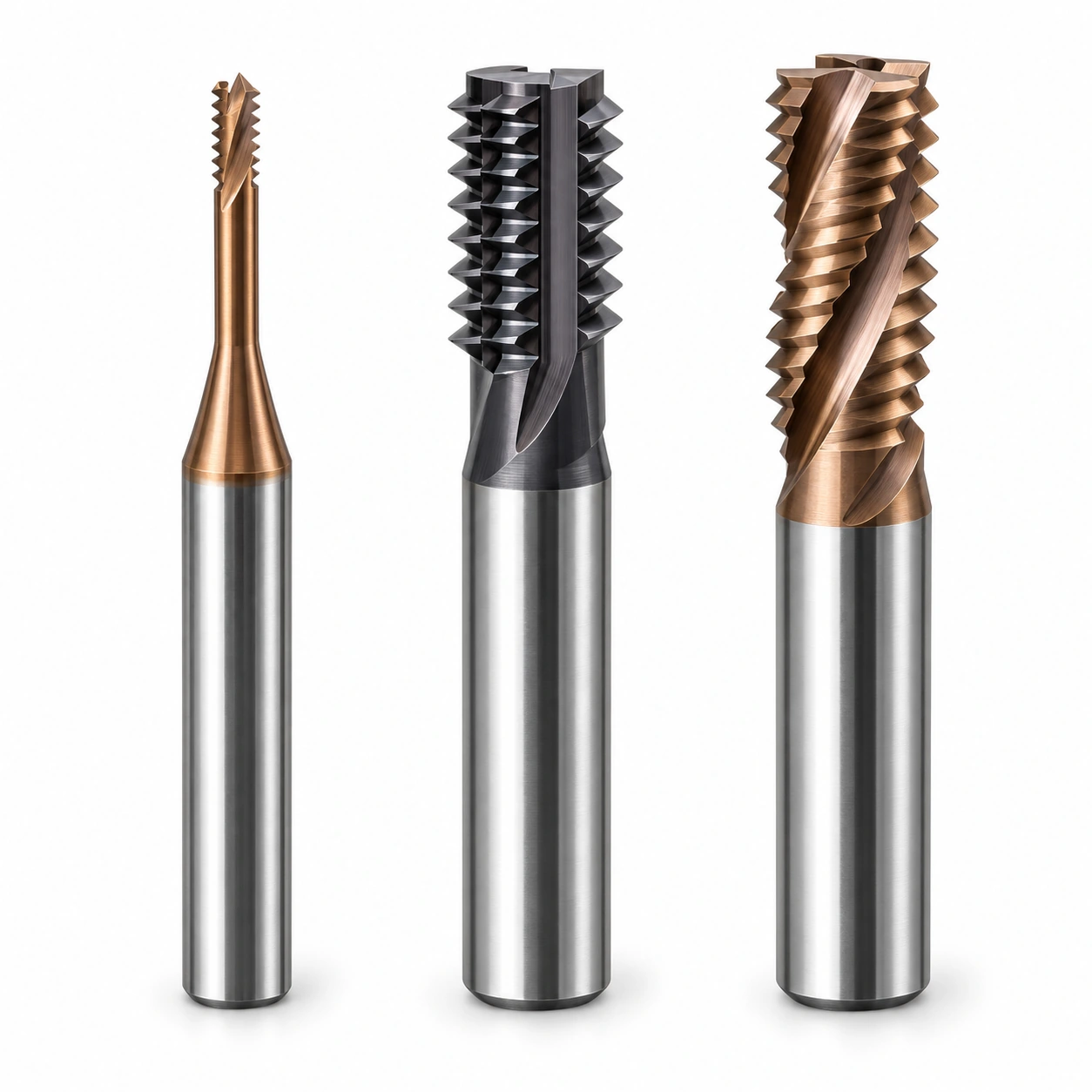
CutNexo's 65 Series Metric Thread Mills catalog contains single-form, 3-row and full-form configurations. They should not be treated as equivalent choices just because a nominal thread size appears in the catalog. Confirm the exact configuration, usable reach and material application.
Use the threading tools collection to compare the available families. A generic milling feed calculation does not create a verified thread-milling program or select the correct hole preparation for a tap.
Information to send for selection
- Drawing with thread standard, pitch, tolerance and full-thread depth.
- Material, hardness, blind/through hole and prepared-hole details.
- Machine, available motion/cycle, holder and coolant delivery.
- Batch size, current tool reference and any quality or chip-control problem.
For a technical reference on process choice, see Sandvik Coromant: thread milling. Contact CutNexo with the part requirements to discuss a matching tool family.