
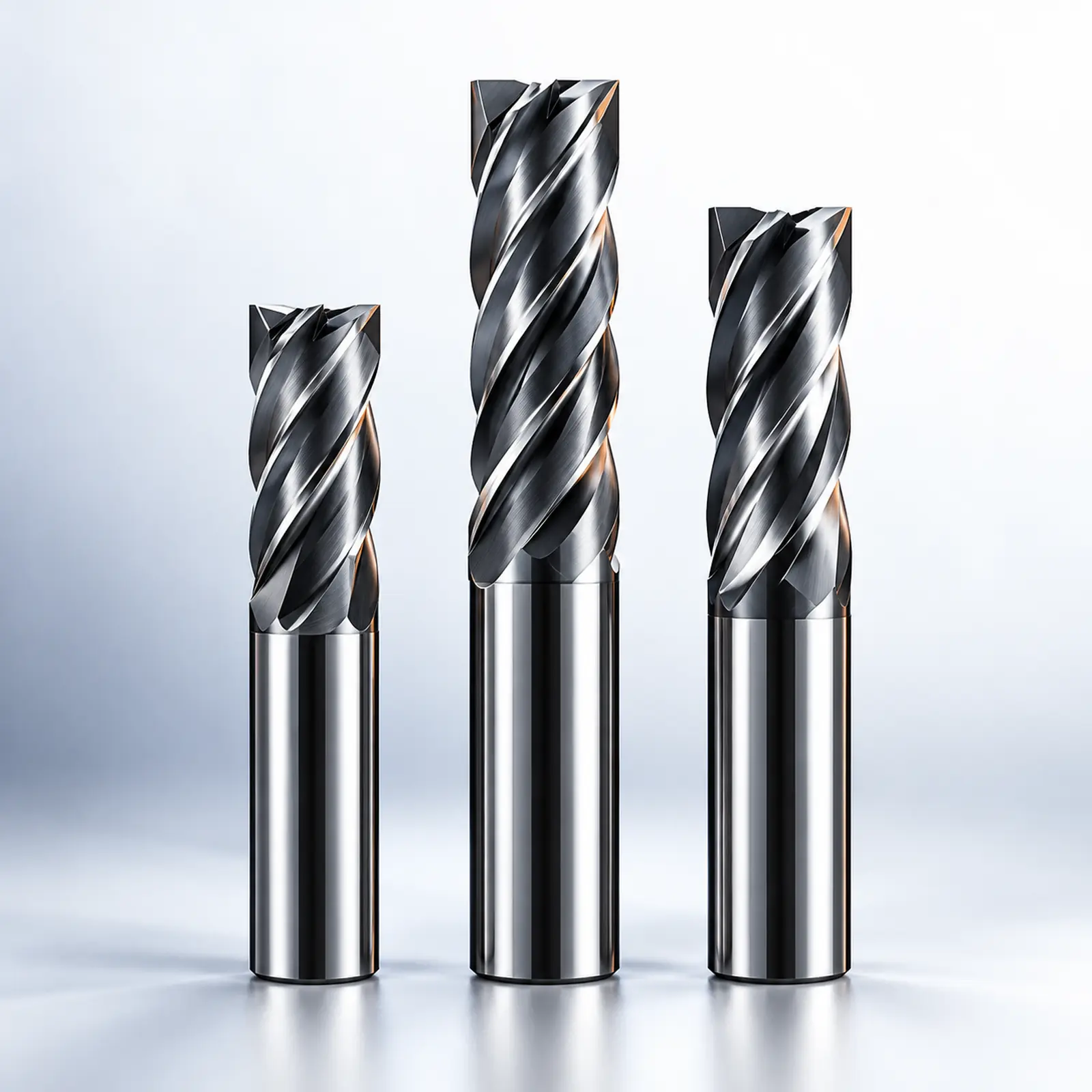
The useful question is not which flute count is always best. It is which cutting geometry suits the material, engagement and setup. Start with the operation, then check the complete tool specification.
A practical comparison of flute counts
| Choice | What to evaluate | Before selecting |
|---|---|---|
| 2 flute | Chip space and cutting-edge engagement for the intended operation | Verify material suitability, centre-cutting capability and permitted engagement. |
| 3 flute | A separate option when matching an aluminum milling application | Compare the actual geometry and cutting data; flute count alone does not establish suitability. |
| 4 flute | Number of cutting edges, chip space and feed requirements | Check whether the tool is intended for full-width slots, side milling or finishing. |
Slotting and side milling ask different questions
A full-width slot and a light side pass do not expose the tool to the same engagement. Record radial and axial depth, how chips will leave the cut, coolant delivery and available spindle speed. Use the tool supplier's engagement limits rather than transferring a setting solely because the diameter is unchanged.
For aluminum, compare the alloy and operation with the specific geometry. CutNexo lists a 3-flute aluminum end mill and a separate general-purpose 4-flute family. These are product families to evaluate, not a claim that either is correct for every job. A 2-flute tool discussed here is a comparison category, not an availability statement.
Why the same feed rate changes chip load
For a basic milling calculation, table feed equals spindle speed × effective cutting teeth × feed per tooth. With 6,000 rpm and an illustrative 0.03 mm/tooth, two effective teeth give 360 mm/min and four give 720 mm/min. Keeping 360 mm/min with four teeth gives 0.015 mm/tooth. These figures demonstrate the arithmetic; they are not recommended cutting settings.
Use the speeds and feeds calculator with data recommended for the actual tool, then check machine limits and engagement. A calculation does not establish a safe process by itself.
What about 3 flute vs 4 flute end mills?
Use the same comparison process. Match the workpiece grade, operation and tool geometry first. Then compare recommended cutting data, chip evacuation and the available size. Do not assume that moving from three to four flutes allows a proportional increase in material removal.
A selection checklist for your next inquiry
- Workpiece alloy and hardness, plus the feature drawing.
- Slotting, pocketing, profiling or finishing; radial and axial engagement.
- Diameter, flute length, reach, holder and tool projection.
- Spindle-speed range, coolant method and current cutting results.
Read the end mill type and selection guide for the broader geometry choices, or send the machining conditions to CutNexo to discuss a specific family.